
LEADING ENGINEERING IN THE AGE OF AI
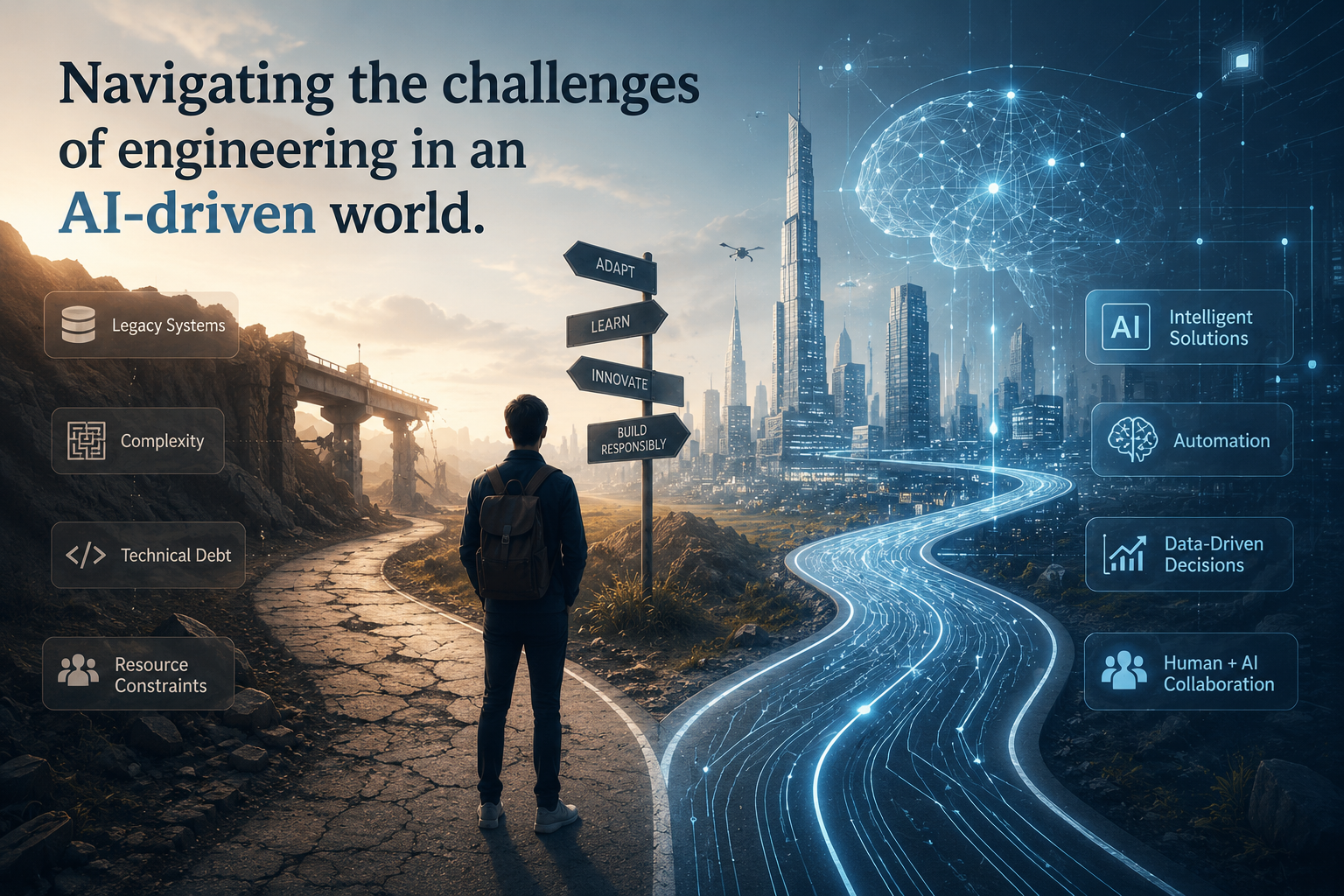
Navigating the challenges of engineering in an AI-driven world.
The Launch Day Dilemma
A week ago, the team gathered in the cramped conference room, the air thick with anticipation. Screens flickered with graphs, each line promising success. Today was the day. The AI platform we’d been building for months was ready to launch. But as the clock ticked closer to noon, I felt an unease creeping in—something felt off.
“Are we sure about the data flow?” asked Jenna, our data engineer, breaking the silence. Her brows furrowed, the faint glow of the screen illuminating her concerned expression.
Her question hung in the air. We had run tests, yes, but the nervous energy in the room suggested we’d overlooked something crucial. As I replayed the last week’s meetings in my mind, a knot formed in my stomach. Had we truly accounted for user behavior? Would they understand the AI’s capabilities?
The Confusing User Experience
As we hit the launch button, I couldn’t shake the feeling. It wasn’t just the technical aspects that worried me; it was the users’ journey. We’d designed a seamless onboarding process, but deep down, I feared that our assumptions about user expectations were misplaced.
The first few hours after launch felt like an eternity. User activity trickled in, but the engagement metrics were disheartening. Sessions were short; people clicked through the interface quickly, but then they vanished. What were we missing?
“Look at this,” Jenna pointed to the dashboard. “Our task completion rate is below 30%. Users are dropping off at the onboarding stage.”
It felt like we’d built an intricate machine, but no one wanted to drive it. The tension mounted as we delved into the analytics. The data told a story, but it wasn’t the one we wanted to hear.
The Tech Behind the Curtain
We had implemented a robust architecture using microservices to manage different components of the AI platform. Each service communicated via REST APIs, designed for scalability. The core engine processed user inputs through a series of NLP models, which then generated personalized responses.
However, as we scrutinized the flow, it became clear that the API latency was higher than expected—over 200 milliseconds at peak times. This was critical; users wouldn’t tolerate delays, especially in a platform built on the promise of instant responses.
Next, we examined the model behavior. The hallucination rate was concerning. Users were encountering bizarre outputs that didn’t align with their queries. It dawned on me that we had chosen a model that wasn’t fully optimized for our specific use cases. “We need to reevaluate our model choice,” I suggested, feeling the weight of our initial assumptions.
The Pivot
The following days were a blur of meetings and late-night coding sessions. We decided to conduct user interviews to gather qualitative data. Speaking directly with users revealed a treasure trove of insights. They loved the concept but felt overwhelmed by the complexity of our interface.
One afternoon, as we pieced together feedback, a realization struck me: we had built for efficiency but ignored usability. Our technical prowess had overshadowed the user experience.
We pivoted to simplify the onboarding process, breaking it into smaller, digestible steps. A progressive reveal of features would help users acclimate. “Let’s track activation metrics closely,” Jenna suggested. “We need to see if this approach increases engagement.”
The Results
Two weeks later, we relaunched. The new onboarding flow was greeted with enthusiasm. Gradually, the task completion rates climbed above 60%, and user feedback shifted positively. “It feels much more intuitive now,” one user mentioned in a follow-up survey.
The API latency had also improved after optimizing our data fetching logic, reducing it to around 100 milliseconds. It wasn’t perfect, but it was a significant step forward.
Reflecting on the Journey
As I look back on the experience, I realize that leading engineering in the age of AI requires more than just technical expertise. It demands empathy for the user, an understanding of their journey, and the agility to pivot when things go sideways.
The balance between cutting-edge technology and user-centered design is delicate. Every decision, from model selection to data flow management, carries weight. In the end, it’s the users who guide the path forward, and it’s our responsibility to listen.
In this age of AI, we must not only build but also connect. What we create should empower users, not confuse them. The real challenge lies in harmonizing innovation with a human touch.