
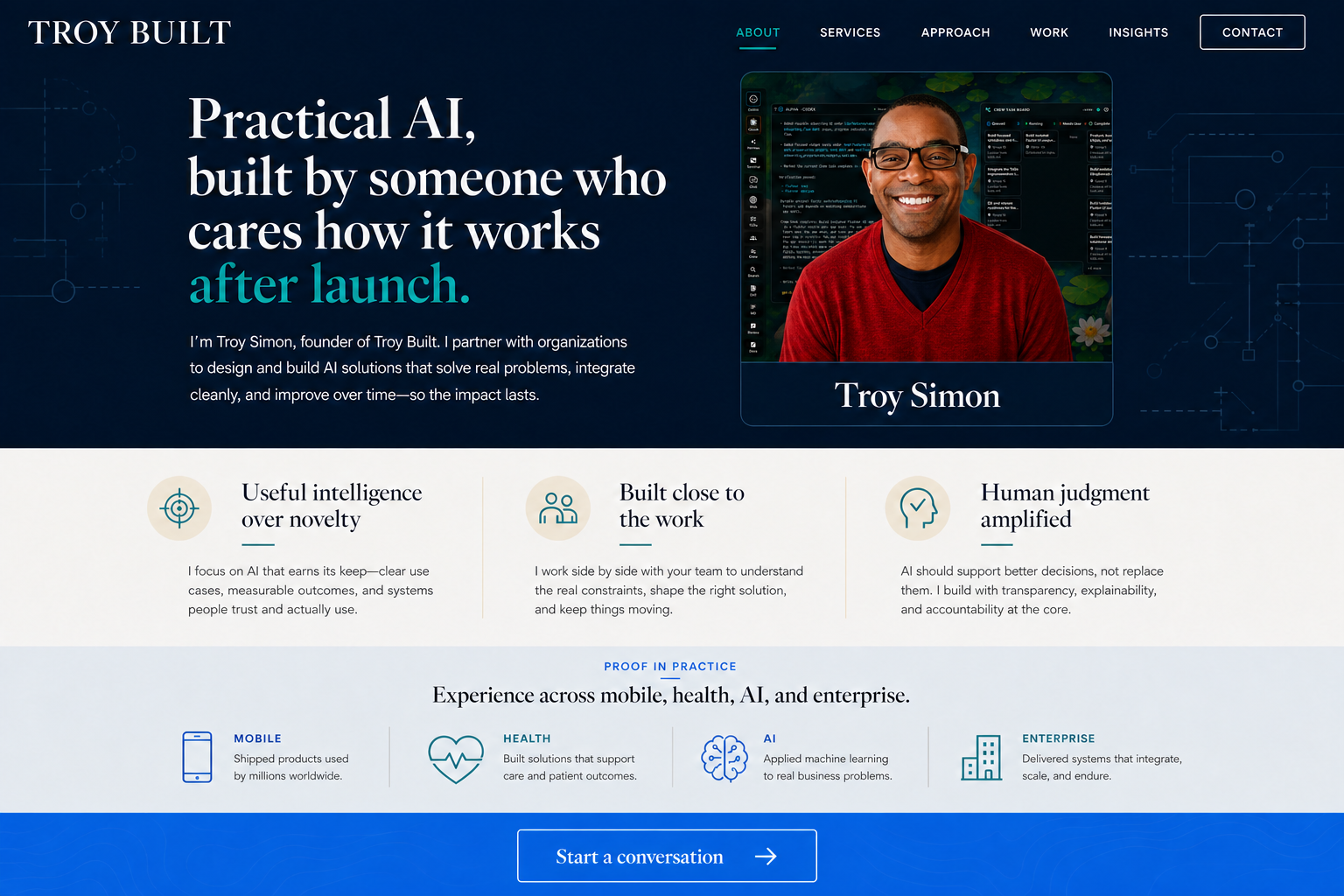
I'm Troy Simon, a product architect, fractional CTO, and full-stack engineer based in Las Vegas, Nevada. I've spent the last decade building software at the intersection of health technology, AI, and consumer mobile. I've shipped products for Comcast/Xfinity, led mobile architecture work at OneLogin, and founded or co-founded ventures including Concierge Health, Gym Farm, and PassHound.
Today I work as a fractional CTO and product partner for early-stage founders who need senior technical leadership without a full-time hire. My focus is AI-powered MVPs across mobile and web: Flutter applications, React and Next.js products, Node.js and TypeScript backends, Hasura and PostgreSQL systems, Firebase products, OpenAI integrations, embeddings, and LLM workflow tools.
The work usually starts with ambiguity. A founder has a product idea, a rough prototype, or a market signal, but not the technical structure needed to ship. I translate that into product scope, architecture, UX, data models, integrations, and a practical release path. I care about the first useful version because a shipped MVP teaches more than a large plan that never reaches users.
Health and wellness products have been a recurring thread in my work, including Concierge Health, Athelon Health, biomarker dashboards, fitness challenge systems, and coaching workflows. I have also built consumer marketplaces, real estate discovery tools, enterprise mobile systems, AI copilots, chatbot builders, and interior design tools through Stellar Corporate.
My product philosophy is direct: make the core workflow clear, prove the riskiest assumption early, choose technology that can survive handoff, and keep AI features tied to a real user decision. I use AI when it improves the product's job, not because every screen needs a chatbot. That means prompts, retrieval, tools, and automations are designed around product outcomes, source visibility, and clear operational limits.
Outside of client work, I stay close to design, photography, and interior environments. Those interests show up in how I think about product surfaces: software should be understandable, useful, and visually composed enough that people trust it before they understand the architecture underneath it.